

id
755162
Edo designations
English designations
Relief Plaque
Location
Frognerseteren Bruk, Kabelgata 34, 0580 Oslo, Norway
Loading...
Relief Plaque
Relief Plaque

Iconographies

4 annotations
Bell
Ẹroro
Bell

Ẹroro (bells) frequently appear as ornaments worn by figures depicted on the Emwin Arre, particularly on Ama-Ẹrọnmwọn (bronze relief plaques) and Aken’ni Elao (carved tusks). These Ẹroro are most commonly quadrangular in form or, less commonly, cylindrical with rounded tops. Quadrangular Ẹroro worn around the neck are often part of the attire that indicates that figures can be interpreted as warriors, alongside the Akọn Ẹkpẹn (leopard tooth neck ornament) and the Ohian Ẹkpẹn (leopard tunics).

1 annotation
Ẹroro
Iconography image
Ẹkpẹn
Leopard

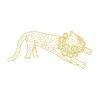
The Ẹkpẹn (leopard) is an animal that appears most often among the motifs decorating the Emwin Arhe (royal treasures). The Ẹkpẹn symbolises the valour and strength of the Ọba, as well as his political authority. The Benin people eulogise the Ọba as the ‘ẹkpẹn n'owa’ (leopard of the home).

When a hunter kills a leopard, he must say “ẹkpẹn n'oha” (I killed a bush leopard), as it is taboo to say that a hunter killed a leopard without specifying that it is a bush leopard, as otherwise this would “be tantamount to symbolically killing the king” (Nevadomsky 1988, p. 81). For this reason, leopards of the bush are called Atalakpa to distinguish them from those that represent the Ọba.

1 annotation
Ẹkpẹn
Headwear
Ẹrhu
Headwear

Many different kinds of Ẹrhu (headwear) are worn by the various figures depicted in the imagery of Benin royal artefacts. Through comparisons with ceremonial regalia still worn by chiefs and members of the royal court, including the Ọba himself, some Ẹrhu have been used to identify the different figures depicted. For example, the conical hat worn by high-ranking town chiefs as part of the pangolin regalia, still worn at ceremonies, is also visible on figures on some Ama-Ẹrọnmwọn (bronze relief plaques). Other examples include the distinctive bell-shaped helmet associated with the Iyasẹ. Figures who wear a shallow-brimmed hat and a cross have been identified as Ewua or Ohensa priests.

Different kinds of helmets and headwear were worn by warriors, reflecting the many different ranks and roles in the army at any given time, as well as developing trends that were in turn represented on Emwin Arhe created at different points in time. Warrior figures wearing helmets covered in cowrie shells were carved on the Aken'ni Elao (carved tusks) (Blackmun 1984, p. 330), yet on the brass Ama, warriors are sometimes depicted wearing helmets made from crocodile hide or horsehair with a front plate (Osadolor in Plankensteiner 2007, cat. no. 238, p. 457). Helmets made from horsehair with a front plate are one of the more common types represented on the Ama-Ẹrọnmwọn, and the demand for black horse tails was noted by both Portuguese and British traders during the late 17th and 18th centuries (Osadolor in Plankensteiner 2007, cat. no. 238, p. 457). Other warriors depicted on Ama-Ẹrọnmwọn wear helmets with a rounded top, chinstrap, and sometimes also a feather tucked into the left side. These types of headwear are known as Ẹrhu Iyokuo.

Attire worn for battle also differed from that worn for ceremonial occasions, such as the pointed headwear worn in combination with an ornate leopard-head tunic by war chiefs. Depictions of figures wearing this attire on brass Ama-Ẹrọnmwọn (bronze relief plaques) have been interpreted as representing the war chiefs’ participation in the war-ritual Isiokuo festival (Osadolor in Plankensteiner 2007, cat. no. 238, p. 457).

Another distinctive form of headwear is that worn by figures identified as leopard hunters on the brass Ama-Ẹrọnmwọn (relief plaques). These large helmets cover almost all of the leopard hunters’ faces except for their noses, eyes, and upper lips, and are made of an unusual material that remains unidentifiable (Plankensteiner 2007, cat. nos. 68–69, p. 322).

European figures are also portrayed with distinctive hats, such as Portuguese three-cornered hats. These depictions reflect the artists’ keen observation and highlight the impact of European trade and military assistance (Ezra 1992).

1 annotation
Ẹrhu
Cat's whiskers facial markings
Itakpa
Cat's whiskers facial markings

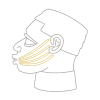
Itakpa facial markings consist of three linear cicatrizations at both corners of the mouth of figures, sometimes described as “cat’s whiskers” by scholars researching Benin art history.e.g., Willett 1967, pp. 67–70 Edo people do not, and did not historically, wear this type of facial marking. Therefore, it has been suggested that these figures could be messengers or envoys sent to the Kingdom of Benin by the Ooni of Ife, as similar facial markings have been seen on terracotta sculptures from Ife.Willett 1967 However, during Joseph Nevadomsky’s research in Benin City, people identified these markings as Itakpa, a kind of facial marking worn by people from areas to the north of the Benin Kingdom, where the Niger and Benue rivers meet, such as the Nupe, Igala, or some Yoruba communities. Furthermore, in his 1937 Edo-English dictionary, Melzian identified Itakpa as the Edo word for the Nupe. During the 16th century, Ọbas led expansion wars, such as the Idah War in 1515–16 under the rule of Ọba Esigie; therefore, the attribution of figures with these markings as ‘foreigners’ corresponds with the history of the Kingdom.

1 annotation
Itakpa

Provenance

4 events
Production
unknown to February 22, 1897 (day approximate)
The object was produced by Unknown member(s) of the Igun-Ẹrọnmwọn guild in Benin City.
Looted
February 19, 1897 (day approximate) to June 1899 (month approximate)
The object was looted by Unknown member of the British colonial military campaign on Benin - February 1897 from Benin Kingdom.
Unknown
February 22, 1897 (day approximate) to 1920
The object is known to have come into contact with Heinrich Umlauff, later in Hamburg.
Purchase
1920
The object was purchased by the UiO, Museum of Cultural History, University of Oslo from J. F. G. Umlauff and Heinrich Umlauff from Hamburg to Oslo.

Institution data

UiO, Museum of Cultural History, University of Oslo
The data was downloaded via a public data access of the institution.
Last updated: 2021-07-01
Languages: english, french, danish
Institution fieldValue
id
object id
755162
description
description
materials/0/mainMaterial
material
bronse
materials/0/mainMaterialEnglish
material
bronze
materials/0/mainMaterialFrench
material
bronze
materials/0/materialGroup
material
Metaller
materials/0/typeOfMaterial
material
metall
materials/0/typeOfMaterialEnglish
material
metal
materials/0/typeOfMaterialFrench
material
métal
materials/0/typeOfMaterialOlChiki
material
ᱫᱷᱟᱹᱛᱩ
materials/0/typeOfMaterialSantali
material
Dhạtu
materials/1/mainMaterial
material
materials/1/mainMaterialEnglish
material
materials/1/mainMaterialFrench
material
materials/1/materialGroup
material
materials/1/typeOfMaterial
material
materials/1/typeOfMaterialEnglish
material
materials/1/typeOfMaterialFrench
material
materials/1/typeOfMaterialOlChiki
material
materials/1/typeOfMaterialSantali
material
Annet_Maal
dimensions
høide 35 cm.
Bredde
dimensions
Diameter
dimensions
Høyde
dimensions
Lengde
dimensions
artefactTerms/0/artefactTerm
object type
bronserelieff
artefactTerms/0/artefactTermEnglish
object type
bronze-relief
artefactTerms/0/artefactTermFrench
object type
artefactTerms/0/artefactTermOlChiki
object type
artefactTerms/0/artefactTermSantali
object type
artefactTerms/1/artefactTerm
object type
artefactTerms/1/artefactTermEnglish
object type
artefactTypes/0/artefactType
object type
relieff
artefactTypes/0/artefactTypeEnglish
object type
relief
artefactTypes/0/artefactTypeFrench
object type
artefactTypes/0/artefactTypeOlChiki
object type
artefactTypes/0/artefactTypeSantali
object type
artefactTypes/1/artefactType
object type
artefactTypes/1/artefactTypeEnglish
object type
artefactTypes/1/artefactTypeFrench
object type
artefactTypes/1/artefactTypeOlChiki
object type
artefactTypes/1/artefactTypeSantali
object type
termNo
object type
bronserelieff
provenance/typeOfUse/place/area
production place
Vest-Afrika
provenance/typeOfUse/place/continent
production place
Afrika
provenance/typeOfUse/place/country
production place
Nigeria
provenance/typeOfUse/place/location
production place
Historisk Benin
provenance/aquisitions/actors/kind
prior source role
person
provenance/aquisitions/actors/role
prior source role
leverte
provenance/aquisitions/actors/personName
provenance
j.f.g. umlauff. hamburg
museum
department and institution
KHM
provenance/aquisitions/eventType
accession method
innkomst
Stb
collType
Etnografi
collections
Etnografisk samling
descriptionNo
description
Relief av bronse med to væbnete personer.
emic/emicArtefact
edo designation
museumNo
object id
UEM26973
ocm/0
Bildende kunst
ocm/1
Kunsthåndverk i metall
ocm/2
Folkelig anatomi
ocm/3
ocm/4
provenance/aquisitions/additionalInfo
Kjøpt
provenance/aquisitions/eventId
755253
provenance/production/additionalInfo
provenance/production/eventId
provenance/typeOfUse/additionalInfo
provenance/typeOfUse/eventId
5116143
thingUuid
7de62deb-e455-4c79-b977-ad3f48798c39
updatedDate
3/27/20
Sensitive Content

Digital Benin collates digital material from institutions, and some of this material is inherently colonial and contains words, terms and phrases that are inaccurate, derogatory and harmful towards African and African diasporic communities. Catalogue transcriptions, book titles, exhibition titles and museum titles may contain harmful terms. We recognise the potential for the material to cause physical and mental distress as well as evoke strong emotions. Owing to the scale of the collection’s data, a process to implement sensitive-content warnings in the displayed data is still incomplete. The material within the catalogue does not represent Digital Benin’s views. Digital Benin maintains a strong anti-colonial, anti-racist position and affirms its support for centring the humanity of historically marginalised and disenfranchised communities. Read more about the background of this statement here